
Civilizations Collapse Through Neglect — And Ours Is On the Brink
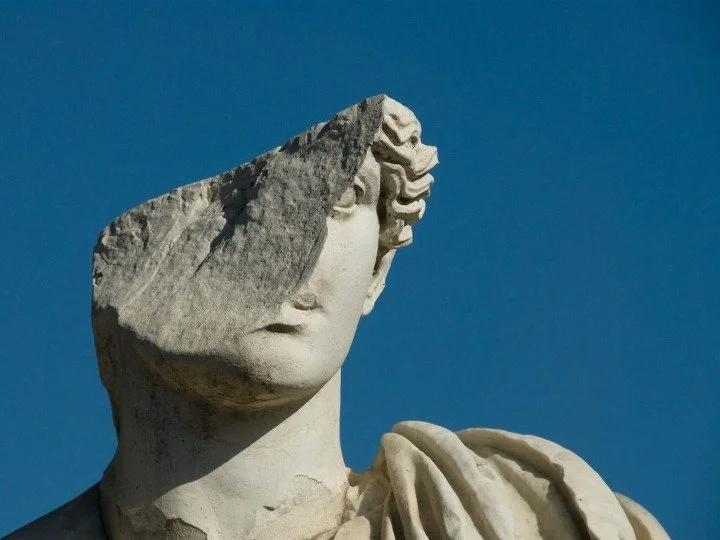
Image Credit: MC Potts
We’ve Kicked Our Problems Down the Road for Too Long — And Now We’re Out of Road
by umair haque
When I think about how history will remember this age, there’s a word, an idea, which keeps occurring to me. By now, it’s eminently clear that this age is marred by many flaws — from fascism to inequality to ecological ruin. And yet running through all that there seems to be to me a thread: neglect. More and more, I think history will regard our age as one of shocking, ruinous levels of neglect.
What do I mean by that? Where do I see neglect? It’s hard not to see it — once you recognize it. This winter, Britain’s planning for blackouts. Its politicians blame Russia, but Britain doesn’t rely on Russia much for gas. Instead, the problem has to do with the fact that the last immense gas storage tank — for emergencies — was shut down just a few years ago, budget-cutting taken to a senseless extreme. Neglect. Europe, meanwhile, which does depend on Russia, put off for too long the question of clean energy — and now the price must be paid, suddenly. Neglect upon neglect. Small examples. But telling ones.
Neglect defines our age. In so, so many ways. From economics to society to ecology. Neglect at this point is probably the defining feature of our civilization — and what’s brought it right to the brink of what seems, every day, more and more like slow-motion collapse. Or maybe not so slow, some days.
When I say “neglect defines our civilization,” what am I talking about? Think about socioeconomics for a moment. Social contracts are barely working at this point, even in sophisticated social democracies — let alone nations like America, which are holding on to democracy by their fingernails, looking down into the abyss of fascism. Social contracts are in profound states of neglect — and feeling abandoned and betrayed, working classes, and then middle classes, turned to demagogues, who pointed the finger at scapegoats. For what? For all this neglect.
Working and middle classes, meanwhile, vast swathes of them, no longer trust institutions, leaders, or even their neighbors. They’re caught in a cycle of neglect — seduced by the far right, having been neglected by leaders on the orthodox left and right for too long, their response is even more neglect. The abused becomes the abuser. The central idea of the far right politics sweeping the globe — even into the heart of social democratic Europe — is to neglect the pillars of democracy, and ensure some kind of secure place in a hierarchy for the Volk, the pure of faith and true of blood, even if that place is only standing atop the ashes of civilization.
In this way, socioeconomic neglect and political neglect accelerate and amplify one another. Our politics has neglected the obvious questions for a very long time now: what are people going to do, as the Age of Industry draws to a close? As their jobs and livelihoods are shipped offshore, the beating hearts of working class life and middle class community slowly coming to a standstill? Our central political problem in this age is that the working and middle class feel neglected, humiliated, left for dead — and they’re not wrong to feel that way. Yet how can the answer be even more neglect, by those already victimized by it — this time, neglect of civilization and democracy itself, in a primal scream of fascism? This way lies ruin — and yet this is the path the world seems to be on, from Italy to Sweden to America and beyond.
Then there’s, of course, ecological neglect. How long have we known that the planet was going to end up this way? Boiling, scorching, flooding, drowning? We’ve known for a very, very long time now. Sure, it might have taken models to “prove” it, to some. But the science has long been established. And yet even knowing what was to come — inevitably come — the response was…indifference.
It was hardly just political leaders who neglected the idea of planetary catastrophe. People did, too, at least if we’re honest. Signs of social attitudes shifting has barely happened to date. By and large, our civilization centers and produces people whose sole priority in life appears to be consumption, at least in the rich West — and in the rest of the world, everyone is essentially captive to their desires.
Think about what it means for a civilization that at this juncture, ours is being hit every month by mega scale impacts of climate catastrophe — and yet green parties are still marginal figures in nearly every nation on earth. There’s something chilling in that, isn’t there? Something about the sheer stubborn perversity with which human beings cling on to the old ways, even in the face of utter incoming disaster.
Those are a few examples of neglect — let me give you one more, that irks me. Why is it that our social contracts are in such disrepair, such states of neglect? Well, it’s because our economies are broken. The average person, who can hardly make ends meet, increasingly can’t afford to fund a modern society at all. The hole in this equation is the fact that the ultra rich and billionaires and even everyday millionaires get away with contributing far too little — the richer you get, the less you contribute, right down to the richest people in the world, like Bezos and Zuck, contributing nothing back to the project of human civilization.
But how can a civilization that concentrates wealth and power to a shocking extreme in the very hands of those whose sole priority appears to be neglecting it…go on? Bezos and Zuck and the rest of these jokers think they can fly off to Mars or live in servers or whatever the infantile-narcissistic escapist fantasy du jour is. All of that is just another way to say neglect. But when a civilization’s entire point has become forever enriching and empowering past the point of any reason the very people who are indifferent to its survival — even hostile to it — of course only one outcome is left: collapse.
I said I’d stop there, but…one more example…that irks me even more. Have you seen the way our societies treat the elderly? It shocks me and stuns me, and usually repels me. They are neglected. They’re shunted off, disappeared, made invisible. No longer “productive,” they have little social priority, next to zero cultural space, and little economic support. Unless, of course, they’re already wealthy. But how can civilizations like that go on, too? We’d be fools to think that our elders aren’t repositories of wisdom, a connection to history, sources of truth. Can a civilization that doesn’t value its elders end up anything other than childish, narcissistic, infantile, repeating history — and doesn’t all that seem to be right where we’ve ended up?
All of that brings me to the question which troubles me lately. Why is neglect the defining feature of our era?